Hiring a commercial cleaner for your St. George or Logan office is an investment — in your facility, your employees, and the impression you make on every client who walks through the door. Like any business investment, it pays to be specific. A vague cleaning agreement leads to inconsistent results, scope creep disputes, and the frustrating cycle of switching cleaning companies every year.
This guide walks through exactly what a solid commercial cleaning contract should include, what the core cleaning checklist should cover, the questions you should ask before signing, and the red flags that should give you pause.
What a Commercial Cleaning Contract Should Cover
Scope of Services
The most important element of any cleaning contract is a precise scope of services. It should specify exactly which rooms and areas will be cleaned, which tasks will be performed in each area, and which tasks are explicitly excluded. “General office cleaning” means nothing. “Restrooms disinfected, including toilet, sink, mirror, and floor mop; break room counters wiped and microwave cleaned; all trash removed and replaced” — that means something.
Cleaning Frequency
Define how often each category of cleaning occurs. A standard commercial setup might include nightly trash removal and restroom service, weekly full cleaning of all surfaces, and monthly deep cleans of floors, windows, and high-touch areas. High-traffic facilities (medical offices, retail, food service) typically require higher frequency across the board.
Supplies and Equipment Responsibility
The contract should clearly state who supplies cleaning products, equipment, paper products, and consumables — and which party is responsible for replenishment costs. Many commercial cleaning companies bring their own products; others expect the client to supply specific materials. If you have preferences around chemical products (low-VOC, fragrance-free, eco-certified), specify this in the agreement.
Insurance and Staff Background Checks
Any legitimate commercial cleaning company should carry general liability insurance and, if they have employees, workers’ compensation. Request a certificate of insurance before signing. The contract should also specify whether all staff entering your facility are employees (not subcontractors) and whether they are subject to background checks — particularly important for offices with sensitive client data or restricted areas.
Satisfaction Guarantee and Complaint Process
Look for a written guarantee that covers re-cleaning if quality standards aren’t met. The complaint process should include a clear timeframe for response (within 24–48 hours is reasonable) and a defined remedy — typically a free re-clean of the affected area.
Pricing Structure and Invoicing
Commercial cleaning contracts can be structured as a fixed monthly rate (predictable for budgeting), per-visit pricing, or hourly billing. Each has tradeoffs. Confirm what’s included in the base rate versus what triggers additional charges. Invoicing frequency (monthly, per visit) should also be explicitly defined.
The Core Commercial Cleaning Checklist
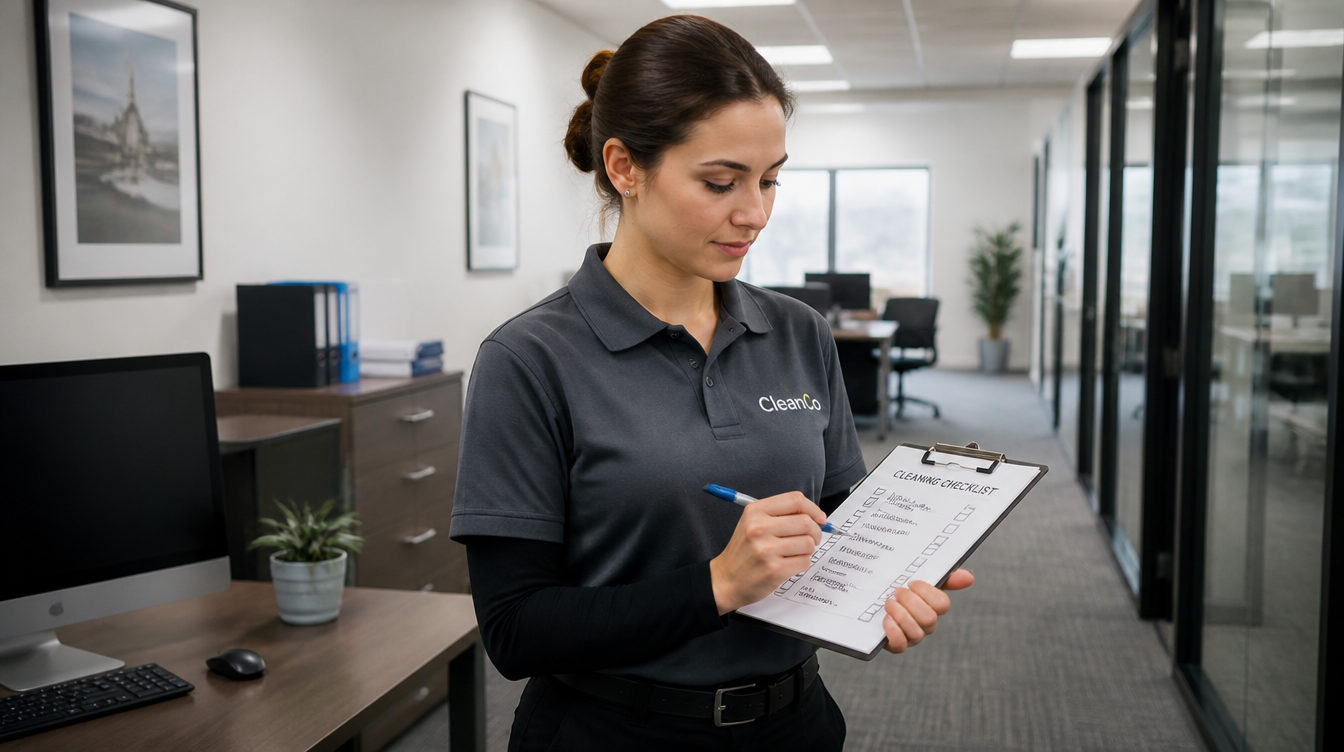
At a minimum, a commercial cleaning contract for a standard office should include the following across all major areas:
Restrooms
- Disinfect all toilets, urinals, sinks, and faucet handles
- Wipe mirrors and countertops
- Restock paper products, soap, and hand sanitizer
- Empty trash and replace liners
- Sweep and mop floors
- Spot-clean partitions and doors
Break Rooms & Kitchens
- Wipe countertops and appliance exteriors (microwave, coffee maker, fridge)
- Clean inside microwave
- Wash or load any left dishes
- Wipe sink and polish faucet
- Empty trash and replace liner
- Sweep and mop floor
- Restock paper towels, dish soap, and other consumables
Offices & Workspaces
- Dust desks, shelves, monitors, and equipment (around items, not on personal files)
- Wipe window sills and horizontal surfaces
- Empty desk-side trash bins and replace liners
- Vacuum carpet or mop hard floors
- Spot-clean glass partitions and interior windows
Lobbies & Common Areas
- Vacuum or mop entry and lobby floors
- Wipe reception desk and high-touch surfaces
- Clean front door glass inside and out
- Dust signage, furniture, and display items
- Empty trash and replace liners
- Spot-clean walls and baseboards
Floors Throughout
- Vacuum all carpeted areas
- Mop all hard flooring with appropriate cleaner
- Edge-vacuum carpeted areas near baseboards
- Periodic deep extraction cleaning (frequency defined in contract)
Trash & Recycling
- Empty all waste bins throughout facility
- Replace bin liners
- Transport bags to designated dumpster/collection area
- Maintain separation of recycling per client instructions
Questions to Ask Before Signing a Commercial Cleaning Contract
- Who specifically will be cleaning my facility — your employees or subcontractors?
- Are all staff background checked before entering client facilities?
- Can you provide a current certificate of insurance?
- What happens if I’m not satisfied with the quality of a clean?
- Do you provide all supplies and equipment, or do I need to supply anything?
- How do you handle access to my facility (keys, codes, security systems)?
- What is the contract term, and what are the cancellation terms?
- Can you provide references from similar facilities in the area?
- How do I communicate issues or feedback between visits?
Red Flags to Watch For
No written scope of services
If a company is reluctant to put exactly what they will (and won't) clean in writing, that's a problem. Verbal agreements leave you with no recourse.
No proof of insurance
A legitimate commercial cleaner can provide a certificate of insurance on request. Anyone who can't or won't is a liability risk for your business.
Subcontracting without disclosure
Some larger cleaning franchises bid jobs and then subcontract the actual work to unknown third parties. Ask directly: who will be cleaning my facility, and are they your employees?
No complaint or re-clean process
Every cleaning company makes mistakes. The good ones have a clear, fast process for addressing complaints. If there's no defined process, you have no protection.
Unusually low pricing
An unrealistically low bid usually means corners are being cut — on supplies, staffing hours, or both. You'll notice it in the quality.
Pressure to sign a long-term contract immediately
A reputable company is willing to earn your trust first. Aggressive pressure to lock in a 12-month contract before you've seen their work is a red flag.
All Things Cleaning provides commercial cleaning services for offices, retail spaces, and commercial facilities throughout St. George and Logan, Utah. We’re locally owned, background-checked, and happy to walk through every detail of what our service includes before you sign anything.
About the Author: All Things Cleaning is a locally owned cleaning company serving businesses in St. George, Logan, and throughout Utah. With 90+ five-star Google reviews, ATC is one of the most trusted commercial and residential cleaning providers in the region.